
Why Preparation Matters Before Installing a Tune

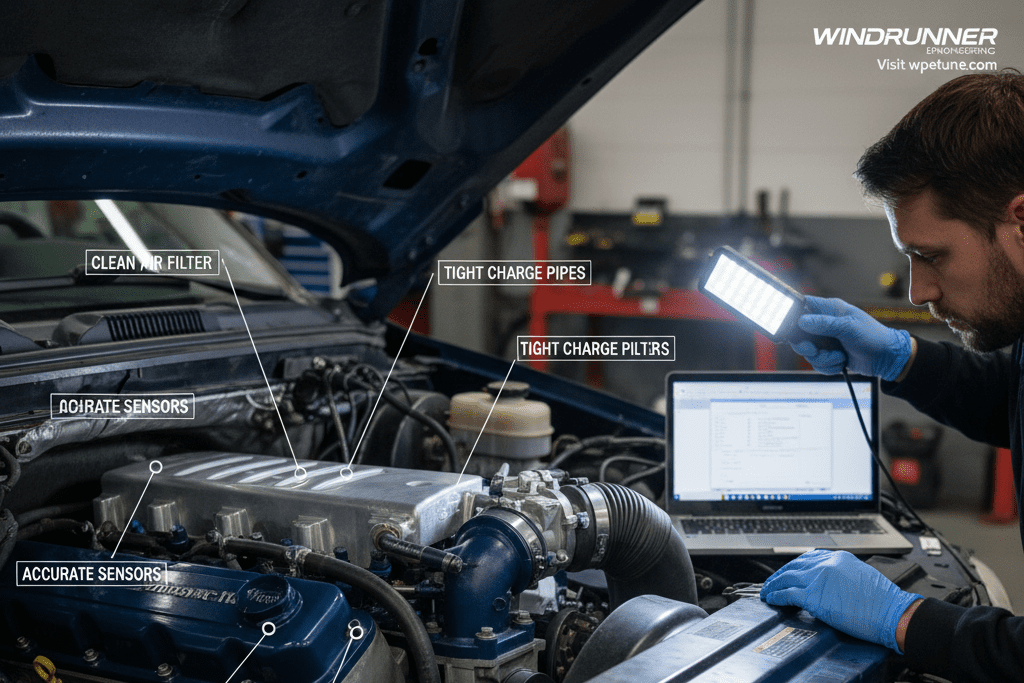
A well-prepared truck delivers safer, stronger, and more reliable results from any custom tune. This guide walks you through a practical pre-tune checklist—so your 6.0 Power Stroke is mechanically sound, sensors read correctly, and your data logs are clean for accurate calibration.
Need personalized help? Visit Windrunner Performance Engineering or contact support for guidance on your setup.
1) Confirm Baseline Health
Before flashing any tune, verify that the engine and supporting systems are healthy. A tune can’t “fix” underlying issues—it can only optimize a good foundation.
- No active DTCs: Scan for trouble codes and resolve them first (fuel, boost, EGR, glow plugs, sensors).
- Battery & charging: Stable voltage during flashing and logging prevents corrupt writes or erratic data.
- Fluids & leaks: Check oil, coolant, transmission fluid; fix any visible leaks before tuning.
- No abnormal smoke/knock: Address drivability problems now; tuning should refine, not mask, issues.
2) Inspect Air, Fuel, and Exhaust Paths
Airflow and fueling consistency are critical for repeatable logs and safe power.
- Air filter & intake tract: Clean, correctly seated, and free of restrictions.
- Charge pipes & boots: Tight clamps, no cracks, no boost leaks.
- Exhaust system: Solid connections, no pre-turbo leaks, EGT probe (if used) installed correctly.
- Fuel filters: Fresh filters reduce pressure drop and protect injectors.
3) Validate Cooling and Oil Systems
Thermal management is a big part of reliability on the 6.0 platform.
- Cooling system health: Good coolant, bled system, proper fan operation.
- Oil condition: Fresh oil of the correct spec supports HEUI injector performance.
- EGT awareness: If towing or running performance files, know your exhaust gas temperature limits.
4) Confirm Sensor Integrity
Bad sensors equal bad data—and bad data leads to poor calibration outcomes.
- MAP/Boost sensor: Clean, accurate, and connected.
- MAF/IAT (if applicable): No contamination; verify readings are reasonable.
- ICP & IPR: Stable readings under load; investigate erratic values.
- EBP system: Clean passages and functional sensor for accurate exhaust backpressure data.
5) Document Your Hardware and Mods
Your tuner needs exact hardware details to match fueling, boost, and timing to your setup.
- VIN and ECU/PCM strategy or OS number.
- Turbo and injectors: Stock vs. upgraded (sizes, brands, nozzles).
- Fuel system changes: Lift pump, regulated return, or aftermarket filtration.
- Exhaust and intake mods: Downpipe, intercooler, intake system.
- Intended use: Towing, daily driving, or performance.
When you order from WPE, you will receive an intake form to capture all of this information accurately.
6) Choose the Right Interface (MPVI/SCT) and Update It
Flashing hardware and software should be current and tested.
- Drivers & firmware: Update your device and its app before connecting to the truck.
- Licensing/credits (if required): Verify you have enough credits/licenses to flash the ECM/PCM.
- Reliable laptop/cable: Use a good USB cable and a laptop with a healthy battery or external power.
7) Prepare for Safe Flashing
A clean, uninterrupted write is non-negotiable.
- Stable power: Maintain battery support or a charger; avoid flashing with weak batteries.
- No electrical noise: Turn off high-draw accessories and aftermarket electronics during the flash.
- Follow device prompts: Do not interrupt the process; wait for explicit completion messages.
8) Capture Quality Logs (If Requested)
Good logs help your tuner refine the file faster and more precisely.
- Warm up first: Log when the engine is at operating temperature.
- Controlled pulls: Use safe, legal roads; replicate conditions your tune targets (towing, highway, daily).
- Key channels: Boost/MAP, ICP/IPR, EBP, EGT (if equipped), fuel pressure (if available), RPM, throttle.
9) Post-Flash Checks
After installing the tune, verify that everything operates as expected.
- No new codes: Scan again; resolve anomalies before further testing.
- Listen and observe: Unusual noises, surging, or smoke indicate issues to address.
- EGT and temps: Monitor on the first drives; ease into full-load operation.
10) Common Pitfalls to Avoid
- Flashing with weak batteries: Risk of bricking or failed writes.
- Ignoring leaks or codes: Underlying issues get worse with added load.
- Incorrect mod details: Mismatched tunes can run poorly and risk damage.
- Skipping logs: Without data, refinement takes longer and may be less precise.
FAQ: Quick Answers
- How long does a custom file take? Most files are delivered within a few business days after we receive your completed intake form.
- Can a tune fix mechanical problems? No. Fix mechanical issues first, then tune for best results.
- Will towing needs be considered? Yes. Tell us your use case—towing, daily, or performance—so we target drivability and EGT control.
When to Contact Support
If you encounter persistent codes, unstable logs, or installation issues, reach out to our team with your VIN, device, mods list, and any logs. Start at wpetune.com via the Support page or AI chat assistant.
Final Takeaway
Preparation protects your engine and maximizes results. With a healthy baseline, accurate mod details, and clean logs, your custom tune will deliver the performance, drivability, and reliability you expect from Windrunner Performance Engineering.